%402x%20(1).svg)
Working With Anxiety – An Experienced Mindfulness Student’s Perspective
Managing anxiety and mindfulness principles
For anonymity’s sake let’s call my student Sean. For years his anxiety was debilitating! He has struggled with it for about 30 years and sought help in many different ways, including counselling and medication treatment. After a course of individual psychotherapy with me, as well as intense involvement in the practice of mindfulness meditation, he eventually got to the point of being able to live without medication, most of the time symptom-free. Maybe once or twice a year he experiences a very manageable recurrence of the anxiety, which he meets with his mindfulness skills.
This article is not about the successful treatment of anxiety disorders through mindfulness meditation. Instead, I want to show how a mindfulness practitioner with quite considerable long-term meditation experience deals with the occasional recurrence of symptoms, particularly when they are extreme. I also want to highlight the mindfulness principles involved in this process.
Sean came to see me recently, because at the beginning of September his anxiety started to reemerge after having been anxiety-free for some time. Nothing unusual had happened and there was no external reason for the recurrence of his anxiety. His anxiety was very bad this time around; it worsened to the point of being almost intolerable and lasted an unusually long time of approximately two months. At its worst, he couldn’t stand it anymore and two things happened: He began to consider the possibility of going back on Cipralex, an antidepressant with a strong anti-anxiety component he is familiar with, which worked well for him in the past. At approximately the same time, he called my office to make an appointment, with the intention of exploring with me anything he might possibly overlook in his psychological approach to his anxiety. Unexpectedly, these two actions of booking an appointment and intending to go back on Cipralex caused the symptoms to vanish. By the time I recently saw him, he almost wondered why he was there with me.
We first talked a bit about how he was managing his anxiety and what mindfulness principles he was applying to deal with it. What he told me was very revealing of quite a skilled mind working with the adversity of an affliction. With many of the principles of meditation that he had learned, such as the recognition that thoughts are not facts, giving emotions a wide spaciousness through allowing and letting be, and sheer tenacity and perseverance, he maintained a deep curiosity about how far this ‘internal catastrophe’ can go. As if he was watching a storm pass by, he simply allowed the inner storm to unfold with as little resistance and as much awareness as possible. Over the years of meeting these symptoms in this fashion, he discovered that nothing more catastrophic happens than an enormous feeling of unpleasantness washing over him, including at times the very unpleasant experience of feeling he is going to die. He discovered a sense of pride and strength in his ability to look the monster directly into the eyes, realizing that the only thing he had to fear is fear itself. Unlike years ago, when such anxiety would have caused him to be out of commission and unable to function normally, he can now continue to go about his life’s business as usual.
He also has access to Ativan, a minor tranquilizer with specific anti-anxiety properties. This is not the kind of medication that would be wise to take on any regular basis, which is why he uses it only very rarely if there’s really no other option, at most maybe one minimal dose tablet once a month if he is really very anxious. He explained to me that he always waits until the storm is over and the anxiety subsides, because it helps him disidentify from the experience, find strength in not allowing the anxiety to control him and significantly decrease the impact the anxiety has on his life. After the worst of the storm is over, he sometimes feels quite exhausted, at which point he may take an Ativan tablet to give himself a good rest. This approach to his anxiety is wise, because while he prevents himself from backing down when the anxiety is at its worst, and instead continues to hone his mindfulness skills to change his relationship to the anxiety, he effectively engages the brain cells in a massive rewiring process that leads to greater integration of his organism, a decrease of symptom strength and the hold it has on him, and therefore longer periods of symptom-free health.
Anyone with some therapeutic experience reading this may wonder, whether he does not actually traumatize himself by doing what he does. The answer is an emphatic no, as long as one important condition is fulfilled: Throughout this process he needs to feel that he is in the driver’s seat, that in other words he remains within his window of tolerance for stress. If during the storm he was to lose his capacity to be aware and apply his mindfulness meditation tools, and instead fell into an unmanageable panic, then yes, it would not make sense to try to be heroic; there would be a real danger of causing more harm than good. After many years of intense mindfulness meditation training, this is clearly not his situation anymore.
A few questions remained: Why did the symptoms disappear the moment he made an appointment and considered taking Cipralex, why did the symptoms start in September when his children are now grown and independent, and there is no back to school stress anymore, and is it wise to go back on Cipralex, which is the kind of medication he would have to take daily for at least a 2 to 3 months period? My answers were not pronouncements written in stone, but hypotheses Sean will have to examine as he continues to develop his expertise in dealing with his anxiety.
The moment he decided he might go back on Cipralex at the height of his anxiety, could in fact psychologically be the moment he surrendered his left brain’s compulsion to solve the problem. Although he was using some cognitive tools to remind him that his thoughts were not reality, this whole anxiety phenomenon can never be resolved with his left brain function alone. It requires an integration of the left brain with the contextual, nonverbal right brain. By surrendering to the possibility that he psychologically may not be able to overcome his anxiety, he relinquished in fact deeper resistances to experiencing these anxious energy flows. The result is an even greater spaciousness with which he relates to his own anxious experience, accompanied by a decrease or even disappearance of the symptom.
Booking an appointment with me would have been an act of faith by hoping I may have some answers up my sleeves that could help him. This could be called a placebo effect, which in fact is not anything negative, but a powerful psychological force that helps us tap into the unknown potential of the organism that we are. Metaphorically speaking, by calling me he actually reached out to his own internal unknown potential for healing. It is not surprising that this would mobilize healing energies that at least temporarily would make the symptoms go away.
With regards to the symptoms appearing in September, I reminded him of all the years his children were growing up and the busyness of life resumed in the fall after a quiet summer. I pointed out the possibility that after many years of conditioning, September has now the symbolic meaning of back-to-school stress, despite the fact that his children are gone and there is no back-to-school stress anymore. Whenever September approaches, his unconscious implicit memories of years of stress, now deeply embodied in his brain’s neurofiring patterns, get activated . This idea struck him as very resonant, causing an immediate additional sense of relief while we were talking. Knowing about this possibility will make it possible for him during the end of summer when fall approaches, to pay particular attention to the fine somatic sensations in his body and whatever faint memories of past years they cause. This may allow him to recognize the mechanism, by which implicitly encoded stress signals from previous years begin to stir in his body when the fall approaches and eventually lead to the development of anxiety.
We can ask an even more radical question: Why bother with such intensive mindfulness meditation training, when one could just take Cipralex and presumably live effortlessly happily ever after? The answer is simple (not simplistic), complex (has many facets) and compelling. On medication people often feel numb or not quite themselves, and they don’t like the side effects. Even with medication the symptoms often don’t disappear and are more likely to be just mitigated. If they do disappear, it is usually time-limited, and over time they tend to return, at which point other medications need to be tried or the dose has to be increased, causing an increase in side effects. Last but not least, the person learns nothing about the psychodynamic meaning of their symptoms, causing unresolved or psychological conflicts to continue to feed the tendency to develop such symptoms and stress, and thus interfere with the overall integration of the organism that promotes the person’s health.
When I talk about these things, highlighting the psychological mechanisms involved in psychiatric symptoms and trying to elucidate the complex decisions that have to be made between psychological and psychodynamic growth and medication treatment, people sometimes come to the wrong conclusion that I am against medication. Far from it. Medication is one of our tools in our toolbox, which wisely used can be extremely beneficial. The problem nowadays lies in the fact that biological advances in medicine have been so spectacular as to eclipse the importance of the mind in our human lives. Whether we like it or not, the mind is still the most important organ we have, and without paying attention to, training and respecting the mind, our attempts at curing illnesses, maintain function and healing fall far short of what is potentially possible.
Copyright © 2018 by Dr. Stéphane Treyvaud. All rights reserved.
Discover Mindfulness Meditation as a tool for Anxiety »
More Blog Posts

An introduction to a movement practice that arises from stillness.
Governing Ground Premise
1. Mobility Mind is mindfulness meditation practiced through movement.
2. Its primary focus is the cultivation of body awareness – learning, at last, to listen to the body rather than merely instruct it.
3. Movement exploration ranges across the whole spectrum of what the body can do, but the aim is never imitation, performance, or comparison. Where those impulses fall away, something more honest remains: the invitation to embrace one's own body exactly as it is, without forcing it toward anywhere else.
1. Mind and Body
My essay 'Emptiness – Four Depths Down and the Medicine of Emptiness' lays the groundwork for the Mobility Mind approach. Before going further, it is worth pausing on two words we use constantly yet rarely understand: mind and body.
The mind is embodied, and the body is minded. Together, as an organism, they form a single functional unit rather than two separable substances glued together. The mind's reality lives in process and relationship, not in a fixed location or a piece of tissue the way the body does. Despite this difference, both are dynamic processes of energy flow on different dimensions of reality, ultimately dissolving into the spacious and empty nature of consciousness when we explore deeply. Consciousness, mind, and body are the same emptiness, manifest in different dimensions with different existential qualities.
Fundamentally, reality is energy flow, and as we work with both Stillness Mind and Mobility Mind, we need to internalize that fact as the ground on which we stand throughout our investigations. Our organism – conceptually divided into mind and body for convenience's sake – is energy flow. We are always dealing with energy flow, whether we sit in stillness, move through postures, or get challenged by disease.
The physical body, which we can cut into and examine under a microscope, is itself energy flow organized to function as our organism's mechanism. The brain and the extended nervous system, of course part of that physical body, serve a function markedly different from any other part of it. The brain is the organ that remembers energy flow that has passed, anticipates energy flow based on past experience, and places energy flow into relationship with other energy flows. This constant creation of new energy-flow relationships is coordinated and organized the way an orchestra plays without a conductor, or the way starlings organize a murmuration. The organizing principle is not a centralized power or authority; it emerges from the relationships between the various energy flows, as what we call an emergent property. In the orchestra, that emergent property is the beautiful sound of the symphony. In our organism, it is the mind. So, while the body and brain are energy flow organized to function as the mechanism of our organism, the mind is energy flow organized to be the regulator of our organism's energy flow. Mind can be defined as the emergent, self-organizing, embodied, and relational process that regulates the flow of energy and information (EIF). Notice the addition of information to energy. Information, too, is energy flow, but of a particular kind: while energy is the non-verbal sense of flowing change we experience through our senses – touch, sight, sound, taste, smell, somatic sensation – or one of the objectively measurable forces that move everything in the physical world, information is the result of complex neuroprocessing that leads to images and thoughts passing through our minds. EIF does not behave like a noun, a fixed thing, but like a verb: an ongoing activity, a process.
In summary, three features carry the weight of this definition of mind:
• Emergent and self-organizing. The mind arises from the interaction of the organism's many parts and regulates the flow of energy and information between them. It is not a fixed substance sitting somewhere; it is a process that keeps generating itself.
• Embodied and relational. This regulatory process arises from, and in turn shapes, the flow of energy and information within the brain and body, and within our relationships with others and ourselves. Mind is not confined to the skull; it is distributed across the body and across the people we are in contact with.
• A verb rather than a noun. Mind is a continuous process unfolding in the organism, not something the organism possesses.
The practical extension of this definition is that well-being depends on integration: a pattern of functioning that balances the organism's chaotic pull toward dissolution against its rigid pull toward fixed structure. When that balance is found, the flow of energy and information becomes flexible, adaptive, coherent, and stable. A healthy mind is one that links differentiated elements well, both within the nervous system and within relationships.
A word about the brain. There is much debate about its relationship to consciousness, and a full account of that debate would exceed the scope of this essay. Some hold that the brain creates consciousness – that consciousness is an emergent property of brain activity. Others hold that the brain functions more like a television set: a conduit for consciousness to become manifest. A program is not inside the television, and the television does not create the program; it only translates a signal, arriving as digital energy, into a visual image. Iain McGilchrist maintains that the brain does not generate consciousness, but that consciousness is ontologically prior to matter, and that the brain is the medium through which consciousness comes into contact with reality. In my own assessment, McGilchrist's framing makes the better sense of the evidence.
In short: working with the body reveals the mind, and understanding the mind changes our relationship with the body.
REMEMBER
The student engaging in Mobility Mind will need to start with a mental shift.
1. We don't have bodies – we are embodied organisms. The body is you, and the mind brings awareness to that.
2. The body is the physical and somatic manifestation of the mind. Walk hunched over, and your mind is hunched over.
3. You are energy flow through and through. Your body, your mind, your reality are always in flow, never static. Any sense of permanence, solidity, rigidity, or immutability is a constructed distortion, or at best a superficial observation.
2. Physical Stillness and Movement
It helps to distinguish two kinds of movement: internal energy and information flow without muscular involvement, as in standing, sitting, or lying still; and movement with muscular involvement, as in motion, dance, and action. The second is visible from the outside, physical or external movement. The first is not visible, and manifests only as flowing subjective experience and states of mind; we will call that mental or internal movement. Life itself does not separate the two, and becoming sensitized to the externally invisible micro-movements that follow the mere intention to move, without actually moving, will be one of the major explorations we engage in here. For the purpose of coming to know the organism we are, the distinction earns its keep.
Physical stillness in sitting meditation removes the conditioned habits of avoiding and defending that normally play out through small and large, involuntary, unconscious muscular movements. It is the classic frame for exploring fine energy and information flows, precisely because it interrupts conditioned patterns and makes room for new connections. The mind, understood as the emergent regulator of that flow, can then be explored in detail, free of physical distraction.
At the same time, the embodied mind inhabits an organism for which movement is foundational, for body and mind alike. An organism without movement derails, physically and mentally. And a mind without physical stillness cannot be properly explored either, distracted as it constantly is by movement. Stillness and movement are both formal frames that open the door to an in-depth exploration of who we fundamentally are: stillness in the direction of the embodied mind's depth of energy and information flow, movement toward the way we embody our mind and optimally use our body.
What we discover, approaching from either direction, is that mind and body share the same foundation: emptiness, the flow of energy and information that can never be stopped. The stillness of sitting meditation leads, by continuously interrupting conditioned patterns, to four potential modes of awareness with emptiness at their core. Conscious movement arrives at the same place by a different route, interrupting conditioned physical rigidities and revealing the malleable, neuroplastic nature of energy flow beneath the body's apparent solidity. Since health and wisdom are both children of integration, and integration is the differentiation and linkage of energy and information flow, it matters that we access reality's depth from both sides at once: stillness and movement together. Neither is a shortcut to the other; each is a different door into the same room, and the room is only fully furnished once both doors have been opened.
Formal sitting meditation could fairly be called 'Stillness Mind,' and movement meditation 'Mobility Mind' – stillness and mobility both referring to the mind's physical dimension. To be healing and creative, movement has to be consciously embodied. That is what Mobility Mind is all about.
The transition between physical stillness and movement with muscular engagement is frequently overlooked. How does internal energy and information flow extend into externally visible movement, and how well are we able to remain connected to the foundational emptiness as we engage the body in physical movement? There is a sequence of steps essential to becoming aware of the relationship between mind and body:
attentional stability in stillness → intention to move that engages muscles without actually moving → actual physical movement → return to pure intentionality → stillness
That chain of events harbours the secrets of conditioning, and with it the opportunity to free ourselves from unhealthy and dysfunctional conditioning. Exploring that transition requires a special technique within the Mobility Mind practice.
REMEMBER
4. There are always mental states, conditioned reflexes, and ingrained habits imprisoning us on the path to the body. Always begin by noticing these the way you would notice a seemingly lifeless beaver dam.
5. Then take your time – a long time – to observe when a beaver stirs and starts to reveal itself to you. Gently coax the body to reveal itself, in stillness, in the transition from stillness to intention to move, and in movement. Once you begin to hear the 'voice' of the body, go with it the way you would go about taming a wild horse, learning its language in the process.
3. Mobility Mind
Nothing in life changes until you actually move. You can read every book on the subject. You can meditate for hours on end. You can repeat your affirmations until you are blue in the face. But if your body stays still, your life will continue to ossify.
Movement is not about fitness. It is not about looking a certain way, and not about strength, reps, numbers, or stretching – not even about playing a sport. Movement is life's primordial dynamic: the emergent, self-organizing, embodied, and relational process that regulates the flow of energy and information through the mechanism of the physical dimension. The body is not a static entity but an ongoing dynamic activity. Movement is an attitude, not something to do.
Movement is primordial. Without it, no mind can develop. When you consciously move, you wake the nervous system up in unconditioned ways it does not otherwise reach. Physical movement and mind movement interact continuously, each shaping the other. The physical stillness of sitting meditation is the envelope that contains physical movement; physical movement, in turn, is the mind made manifest and the envelope that contains stillness.
Movement shows you your defenses. It reveals the unconscious through the body's implicit conditioning, and it reveals the mind indirectly, precisely because it is non-conceptual.
So the real question is not 'how do I fix my life?' It is: 'how do I start moving today, in a way that reprograms everything else within me?' Movement is a full system reboot, a remodeling of who you are as a human being – what you accept, what you tolerate, what you believe about yourself and the world around you. It is one way of building a new relationship to yourself, and by extension, to others.
Here is the part most people miss: movement changes the state of your nervous system, and the nervous system regulates everything. Every decision you make, every emotional reaction, every habit you build, every breath you take, every ounce of energy you spend, and every way you show up in the world runs through it. Whether you fight, flee, freeze, or stay calm under pressure – that is your nervous system deciding.
REMEMBER
6. Never fight your body, because fighting it means fighting yourself. Your body is not your enemy, but your friend and teacher.
7. Right from the start, play with your body. Every movement is an opportunity to play and explore the way children explore. Don’t be too serious.
4. Mobility Mind And Trauma
People with a history of trauma – whether complex, developmental trauma or a single-event trauma – frequently find it very challenging, if not impossible, to sit still and meditate. The somatically encoded trauma energy held in the body means that stillness itself, rather than being restful, can feel unbearable. This does not mean, however, that such people cannot meditate. It is a matter of finding the approach that meets the individual where they actually are.
Within the physical stillness of sitting meditation, certain modifications are available. But when a person cannot be still, that is where movement meditation – awareness through movement – comes in. Such an approach has been well known for decades: the Feldenkrais Method, though it is not usually considered a form of meditation as such. Mobility Mind borrows from Feldenkrais and extends it to encompass the full range of movement – fast and slow, stretch and strength, every direction, plane, and angle – as a way of finding freedom and stillness through movement rather than in spite of it.
5. Ten Rules That Guide Mobility Explorations
These rules, inspired by Vanja Moves and adapted for our purposes, are not so much a checklist as a set of reminders – the kind worth returning to whenever practice drifts toward habit.
• Rule 1: Movement is not a workout – it is a way of life. As a web weaving through your life, it belongs in the whole of your day, not only in a session set aside for it. Movement is not part of life; life is movement.
• Rule 2: Fix the dysfunction first, then build the body. Strength layered on top of a compensation only entrenches the compensation. It takes patience to examine dysfunctions closely within a whole-body context, so that they can slowly dissolve into a vibrant organismic integration.
• Rule 3: Pain is not a punishment or an inevitability – it is a message. Learn to read what it is telling you before deciding whether to work through it, around it, or to stop. The reflex is to want to avoid or get rid of pain; both lead to more pain and dysfunction. Pain requires skillful exploration and an attitude that sees it as a guide, not an enemy.
• Rule 4: Master positions or postures before you chase progressions. A position held with integrity is worth more than a progression reached without it. Unexamined positions perpetuate misalignment and chronic degeneration.
• Rule 5: Every rep is an assessment – every set is a conversation. Each movement tells you something about your relationship to yourself, about where you actually are today, not just what you can perform. Movement illuminates the states of mind that define your life.
• Rule 6: Flexibility without strength is fragility, strength without flexibility is rigidity, and strength without movement is useless. Flexibility, strength, and movement depend on each other; range of motion is only as good as the control you have over it.
• Rule 7: You are not here to look fit – you are here to be a capable human being. Capability shows up in how you move through an ordinary day, not in how you look in a mirror. Your posture manifests your state of mind.
• Rule 8: Leave no joint behind. Every joint deserves attention, not only the ones that are already strong, or already sore.
• Rule 9: You build the body for life, not just for now. Train with the body you will need in twenty years in mind, not only the one you have this year.
• Rule 10: Discipline without forcing must become your default. The awareness this cultivates opens the door to discovering your own need for mobility. Once you feel that need, you can dispense with waiting for motivation, and freely engage in the expression of mobility as its own reward. Show up consistently, let the body tell you what it actually needs, and let movement become, in time, a form of self-expression.
6. Fundamental Movement Patterns
Practice moves through families of movement patterns, each addressing a different layer of how the body organizes itself in space.
• Core strength and control of the line. Shoulder mobility, scapular control, rib tuck, wrist integrity, core compression, hip strength, knee and ankle mobility. This is the foundation everything else is built on.
• Crawling patterns, ground flow, and squat transitions. These return the body to primal coordination between the upper and lower halves.
• Single-leg balance and unilateral strength work. Training each side independently is where hidden imbalances tend to surface. Simultaneously, we train to maintain our important capacity for balance.
• Dynamic back bends and spinal extension. Opening the spine in the direction most daily life neglects. Both life and age tend to fold us forward and down toward the earth, through a subtle sense of heaviness, fatigue, and carrying the world on one's shoulders. It is important to counteract that tendency.
• Twists. With age, our world shrinks increasingly into sagittal movement patterns that avoid twists, resulting in restricted head, upper-body, and pelvic turning.
• Rolling patterns and spinal reset. A rhythmic, controlled way of resetting the nervous system's relationship to the spine. As we lose the sense of play, become stiffer with age, and grow increasingly afraid of falls, we quit rolling. Our movements become increasingly angular as they lose the smooth flexibility of rolling.
• Dead hanging and resting squats. A powerful way to open and strengthen the shoulders, and to decompress the spine.
7. Mobility Orientations
Beyond the patterns themselves, a set of mental orientations shapes how the work is approached.
• We always begin by coaxing the body out of its protective, rigid shell, and then invite ourselves to play with it through joy-filled repetition.
• State of mind toward movement. Monitoring one's present-moment attitude toward movement reveals possible resistance to moving, and ways to neutralize it. The state of mind brought into a session shapes what can actually be received from it.
• Exploring the transition from stillness, via intention, to movement. This transition is one of the clearest manifestations of the present moment's unfolding. Become intimately familiar with it, and your whole movement demeanor will transform.
• The freedom envelope – the green, yellow, red-light metaphor. Green, or solidification: easy, effortless, flowing. Yellow, or transformation: challenging, effortful, exploring resistance. Red, or inhibition: pain, danger, forcing, excess.
Alongside this, a further distinction is explored between pain, stress (tension, pressure, twist, ache), and ease.
• Two kinds of movement. Internal – mental energy and information flow without muscular involvement, as in standing, sitting, or lying still. External – physical movement with muscular involvement, as in motion, dance, and action (see above).
• Liberating the spine in the gravitational field. Cultivating awareness of the gravitational field and its effect on our body. Finding and remaining connected to the earth by feeling our rootedness, and creating space by stacking the spine and expanding upward, toward the sky's spaciousness. Constant counter-directional (down and up) awareness: Where is the earth, to ground myself? Where can I create space?
• The foundation of flow: breath and voice. Breath and voice are the first movements we make, and the most constant.
• Movement dynamics and direction. Slow to fast, small to large, smooth to jagged, gradual to sudden: learning to move across the whole spectrum, rather than defaulting to one register. And moving in a 360-degree spherical space.
• Strengthening and stretching. Held in relation to each other, not pursued as separate goals.
• Animal imitations. A wonderful way of lubricating stiff joints and creatively discovering new movement patterns that liberate the organism.
• Remembering child mobility. The capacity to be playful and creative, and to move without the self-consciousness that accumulates with age.
• Aesthetics: the transition to beauty and dance. Movement, refined over time, becomes a form of expression in its own right.
8. Working with Pain and Limitations
Pain, in this work, is treated as information rather than obstacle, in keeping with the distinction already drawn between pain, stress, and ease. Everyone arrives with a different history – age, old injuries, stiffness, past surgeries, and asymmetries built up over years of favoring one side or one pattern. The practice works both within and around those limitations, using the freedom envelope described above as a practical, real-time way of judging whether a given movement belongs in the territory of exploration or the territory of harm. Working with limitations, understood this way, is not a separate track from the main practice; it is the practice, applied honestly to wherever the body happens to be today. The limitation is an aspect of your organism's form in this moment. It is an aspect of who you are.
Never avoid or try to get rid of pain. Pain is a teacher to be embraced and worked with, not an enemy to be shunned or destroyed.
9. Conclusion
Mobility Mind is, in the end, an invitation: to discover, through movement, what stillness alone cannot show you, and to bring the same attention you would bring to a cushion to the way you walk, crawl, bend, and roll through an ordinary day. The work consists, fundamentally, in learning to stop trying to feel better, and finding instead the curiosity, need, and passion to follow the scent of truth – no matter the difficulty of doing so.
Stillness teaches you what you are beneath the body. Movement teaches you what the body is beneath its solidity. Between the two, nothing is left standing outside the flow – not even, in the end, the search itself.
Copyright © 2026 by Dr. Stéphane Treyvaud. All rights reserved.
Victoria Mortis: An invitation to transcendence
Notes on Owe Zerge's Victoria Mortis for the work at The Mindfulness Centre

Some version of this roomexists in every house that has ever sheltered a person. The furniture keepschanging; sometimes there is no table at all, only a bed, a hallway, a hospitalcorridor with the light turned low, a roadside at two in the morning. Owe Zergepainted his version in 1921: a young man, stripped of everything but his ownskin, bent over a chessboard against a visitor who has clearly been expected,if not exactly invited.
The painting belongs to anolder family of images. There is the medieval Dance of Death; there are theSwedish church murals a young Ingmar Bergman once stood beneath and laterpoured into the chess game of The Seventh Seal; there is the whole long Europeanhabit of putting a skeleton at the table and asking what a person does with thetime that is left. What Zerge adds to that lineage is the nakedness. Earlierversions dress their doomed men in the armour of knighthood or the robes of theclergy; Zerge undresses his, and in doing so removes the last alibi. No rank isleft to hide inside, no office to retreat behind, no title that might negotiatea different outcome with the visitor across the board. What remains at thattable is simply a mind, a body, and an amount of time neither of them gets toset, even when disrupting the chess game to delay the inevitable buys us atemporary reprieve. Remembering this nakedness, my approach to the MobilityMind program dispenses with such notions as advanced or beginner.
I
Begin with the bareness,because the painting does. We are used to nakedness as vulnerability, somethingto be covered, apologised for, or eroticised. This is a different register ofundress, closer to what Heidegger meant by thrownness: the plain fact of havingbeen delivered into existence without ever having been consulted about theterms. No one asked the young man in the painting whether he wanted a body thatages. No one asked whether he wanted a mind that fears, or a clock running inonly one direction. He simply woke up inside the arrangement, the way all of usdid, and the painting's first honesty is to show him without the elaboratescaffolding we build afterward to make that arrangement feel chosen.
Diogenes the Cynic understoodsomething of this when he made his home in a barrel and owned almost nothing,not out of poverty but as a standing argument. Most of what we call our life,he seemed to be demonstrating, is decoration laid over a smaller and moreexposed fact, and a person willing to strip the decoration away gains a freedomthe well-dressed rarely have access to. The boy at Zerge's table has not chosenhis nakedness in that deliberate way; it has simply been given to him, the wayit is given to everyone, sooner or later, by illness, by loss, by a diagnosisspoken in a small room, by the plain arithmetic of years. Yet the painting asksus to notice that this exposure, however involuntary, may be the truestself-portrait any of us will ever sit for, since everything else gets returnedto the wardrobe eventually, while the body was never really borrowed to beginwith.
II
And yet look at the effort inhim: elbows locked against the table, fists pressed to a brow furrowed into asingle, narrowing corridor of thought. This is not the loose attention ofsomeone simply thinking. It is the clenched labour of a mind trying to thinkits way out of a room that has no other door. Ernest Becker gave this labour aname and a whole psychology of its own in The Denial of Death. A great deal ofhuman striving, he argued, culture, ambition, even love, functions as anelaborate immortality project, a set of structures built so that some part ofus will seem to outlast the part that cannot.
We rarely experience this asdenial while we are inside it; it feels, from where the young man sits, urgentand reasonable, a person simply doing his best with the position in front ofhim. Centuries before Becker, Pascal noticed something similar and gave it ashorter name: divertissement, diversion. A man would rather chase a hare acrossa field all day, he observed, than sit quietly alone in a room, not because thehare matters but because the sitting brings something unbearable too close. Thechessboard works this way for the young man too. Far from being idlerecreation, it is a magnificent, socially sanctioned distraction, a taskcomplicated enough to fully occupy a mind that would otherwise have to feelwhat it is actually facing, which is why so many of us recognise the posture:the calendar kept too full to leave room for the question, the inbox refreshedone more time before the harder conversation gets started, the achievementchased mainly because the chasing postpones something quieter and largerunderneath it.
III
The choice of chess for thisparticular confrontation is close to the whole argument, folded into a singleimage. Of all human games, chess flatters the intellect most completely, theleft brain above all: a closed system, finite, rule-bound, in principleexhaustible by sufficient calculation, the one arena where cleverness reliablywins if the calculating mind is patient and precise enough. Bring that samemind to a table across from Death, however, and the flattery collapses, becausethe terms of this match were never symmetrical to begin with. No opening theoryoutlives a failing heart, and no matter how many moves ahead the young mansees, the seeing itself draws down a reserve that winning the position in frontof him cannot replenish.
Here is the joke the intellectkeeps failing to hear: it was hired to win a contest whose actual terms weredecided before the first piece was ever moved. Death does not need to play abetter game. Death only needs to keep the appointment made the moment the youngman was born. Recognising this early rather than late is close to a mercy,because the alternative, the quiet, lifelong conviction that enoughintelligence, enough foresight, enough discipline might eventually out-arguemortality, or the foolish fantasy that an imagined perfection of an afterlifewill compensate for all the miseries of this existence, is a belief capable ofconsuming an entire life in the arguing. And losing anyway. And losingadditionally every year spent refusing to notice the actual shape of the gamebeing played.
IV
Beside the board, easy to misson a first look, an hourglass keeps its own counsel. It offers no dial, nonumerals, no argument on behalf of either player. Sand falls at the same ratethrough triumph as through dread, indifferent to which of them is winning,simply following physics' laws. European painters of the sixteenth andseventeenth centuries loved to set precisely this object beside a skull and aguttering candle in their vanitas still lifes, because an hourglass makes norhetorical case at all. It measures by flowing, indifferent to whichever storyeither of us happens to be telling ourselves about how the match is going.
Augustine, turning the natureof time over in the eleventh book of the Confessions, arrived at a related andequally unsettling observation: that the present, examined closely, is notreally a duration we ever get to hold. It is a knife-edge between a past thathas already escaped and a future that has not yet arrived, so narrow that bythe time we notice we are standing on it, we have already been carried past. Takingit a step further, the present moment has a timeless duration that is our lives’essence, a dimension we ignore at our own peril. The hourglass in Zerge'spainting does Augustine's work quietly, in wood and glass, at the edge of amatch neither player is watching it play. Its presence relativizes the entirecontest without raising its voice, because whatever the outcome of this particulargame, the falling has been happening the whole time regardless. What wasactually at stake was never the position of the pieces. It was the grainsalready fallen, which cannot be walked back up the glass, the grains stillwaiting their turn, over which no one at that table, on either side, has everbeen granted the smallest authority, and above all, the timeless falling itself.
V
Then there is the face: Death'smouth caught in an unsettlingly double expression, teeth bared in somethingthat refuses to resolve into either menace or mirth no matter how long a personlooks at it. Northrop Frye's account of the shapes stories take offers a way tohold both readings at once rather than forcing a choice between them, since hetraced the human imagination's narrative modes through a cycle running fromcomedy through romance into tragedy and finally irony, each carrying its ownparticular relationship to fate and desire.
Read the smile ironically, inFrye's winter mode, where the world's actual outcomes mock human aspiration,and it becomes the driest possible punchline: every plan a pretension, everycareful calculation met by a grin that has watched this exact scene resolve tenthousand times already. But read the same smile romantically, in the sense ofthe quest narrative where a hero descends into danger in order to returntransformed, and the expression softens into an invitation, even a kind oftenderness. It becomes the smile of a guide standing at the mouth of the onejourney that keeps no secrets, offering no false rescue and therefore incapableof the betrayal easier companions eventually manage. What makes the paintinggenuinely unsettling rather than merely grim, and what amounts to pureright-brain intervention at its best, is that it refuses to let the smilesettle into one register. It insists on both, the way the wisest teachers ofalmost any tradition tend to insist that the frightening and the liberating turnout, on sufficiently close inspection, to be the same fact seen from twodifferent distances.
VI
Here contemplative andphilosophical traditions converge on an observation that sounds paradoxicalonly to a mind that has not yet tested it: holding mortality in steadyawareness, rather than at arm's length, enlarges the room a life gets to happenin. Heidegger called the alternative to this awareness das Man, the anonymous"the They" or "the Anyone," a public mode of existence inwhich individuals conform to societal norms and expectations rather than actingauthentically. Through idle talk and endless deferral, das Man manages neverquite to arrive at its own death as a real and present fact, treating dying assomething that happens to other people, reported at a comfortable distance.
Authentic existence, in hisaccount, requires the opposite move, what he called Being-towards-death: awillingness to hold one's own finitude close enough that it organiseseverything else honestly, rather than being managed from a safe philosophicalremove. The Stoics, working several centuries earlier and along a considerablyless mystical road, arrived at a related practice by a more practical route.Seneca advised his correspondents to rehearse loss in the imagination before itarrived, a discipline later writers called ‘premeditatio malorum’, on thetheory that a person who has already walked toward the worst case in thought isfar less enslaved by the fear of it in fact. More than a thousand years later,Montaigne distilled the whole tradition into a single working sentence heplaced at the head of an essay: "To philosophise is to learn how todie." Rilke hoped for something more intimate still, not a generic deathhanded out identically to everyone but what he called one's own death, ripeninginside a life the way fruit ripens on its particular tree, shaped by everythingthat life actually was. Ivan Illich wished not to die of illness, but of death.And fully embracing ‘the full catastrophe’ of life through mindfulnessmeditation means, for Buddhists, that "if you die, before you die, youwill not die, when you die."
What these very different mindsare describing, across their very different centuries, is the discovery theyoung man at the chessboard has not yet made. A mind that keeps deathpermanently at the edge of vision spends enormous, unacknowledged energy maintainingthat peripheral blur, and the space left over for actually living shrinks tothe size of its own vigilance, a smaller and smaller room maintained at greaterand greater cost. Turn and look directly, and most of what felt unbearablyurgent a moment before turns out to have been urgent only within the comfortingfiction of unlimited time, a fiction so constant that we mistake it for theweather rather than for something we ourselves keep manufacturing. Remove thefiction, and the present stops rushing toward a door at the far end of acorridor. What is left, quite simply, is the room itself, timeless not becausetime has stopped but because there was never anywhere else it was supposed tobe rushing to in the first place.
VII
So the young man's mistake wasnever the quality of his chess. It was the frame he brought to the board. Playagainst Death to win, and every game resolves the same way, because the termswere fixed before the pieces were ever set out, fixed, in a sense, from thefelling of the tree the table itself was cut from. Play chess with Death ratherthan against him, though, and the entire board changes its meaning without asingle rule being altered. What had been a contest over who outlasts whombecomes something closer to a disciplined dance, a structured, formal, almostceremonial way of sitting in proximity to nihility without being dissolved byit, not unlike what a meditation cushion offers a mind that has never beforetried sitting still with its own groundlessness.
Zen practice has a phrase forthe state this requires: don't-know mind, the willingness to remain in genuinenot-knowing rather than reaching immediately for the reassurance of an answer.The Buddhist tradition of deliberate contemplation of death uses structuredreflection for exactly this purpose, not to frighten the practitioner intoparalysis but to give the enormity of impermanence a shape small enough toactually sit with, the way sixty-four squares give the enormity of a game ashape small enough to actually play.
This is the shift my work atThe Mindfulness Centre keeps returning to, across every different vocabulary ituses to teach it: not the abolition of groundlessness, which is on offer to noone, but a change in our relationship to it, from something braced against withclenched shoulders to something a person can, with practice, learn to sitinside on purpose. I will never forget Karlfried Graf Dürckheim’s words when Iwas too young to fully absorb them: "Anyone past forty, who is notmeditating on death every day, must be out of his mind."
VIII
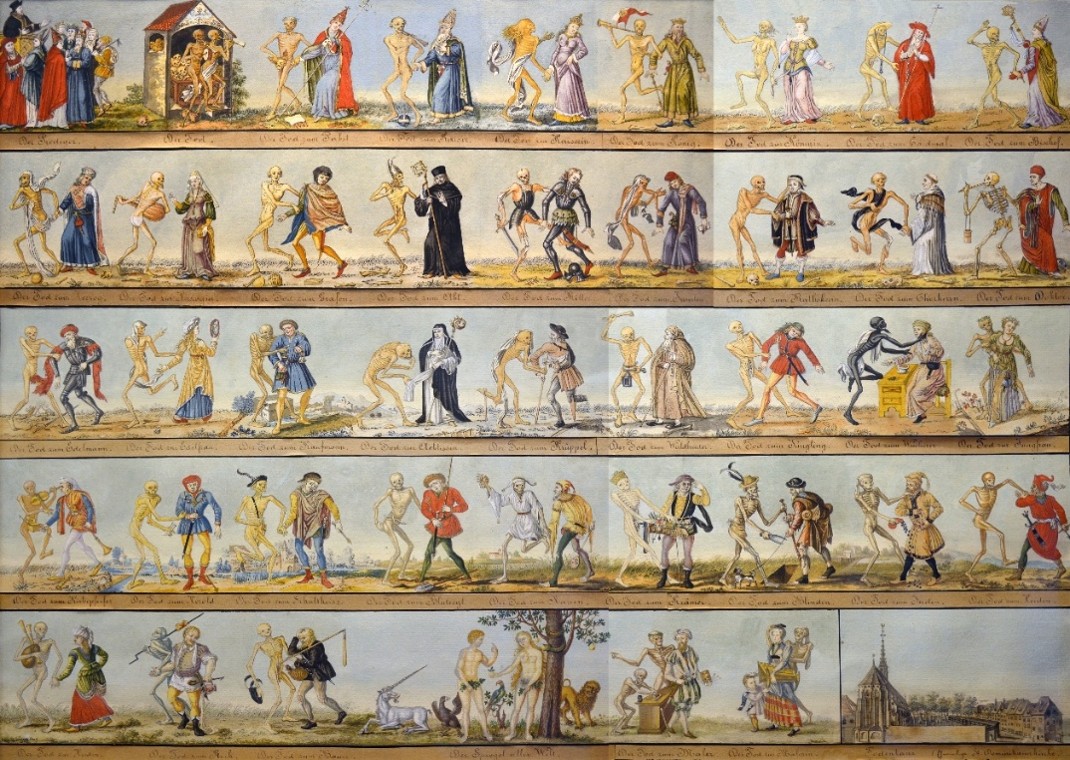
An adversary has to be defeatedor it defeats you. There is no third position available, which is exactly whatmakes adversarial relationships so exhausting to sustain over an entirelifetime. A dance partner offers a genuinely different structure: leadingsometimes, yielding sometimes, moving with a person rather than merely at them,so that the measure of the encounter stops being victory and becomes insteadthe quality of the movement, moment by moment. This, in fact, may be the olderand truer reading of the whole tradition Zerge is painting inside. The medievaldanse macabre from which the entire chess-with-Death motif eventually descendswas not originally imagined as combat at all but as a dance, a skeletal figuretaking the hand of the pope, the child, the merchant, the beggar, and leadingeach in turn into the same procession, regardless of what any of them hadaccumulated along the way. Basel's history museum houses the remnants of afresco from the late Middle Ages, around 1440, called Totentanz, death's dance,faded now but still legible enough to serve as a reminder of our sharedexistential roots.
Taoist thought offers aparallel structure from an entirely different hemisphere. The practice thetradition calls wu wei, and the martial art of push-hands built directly on it,teach a student to meet incoming force not by opposing it head-on, which tendsto break the person with less mass, but by yielding into it, redirecting it,moving with it until the line between the two forces meeting starts to blur.Relating to death this way is not resignation in a nicer coat; it is an actualchange of partner, and the strange gift of that change is what happens to theold battle lines it dissolves. Existence defended on one side of the table,nihility attacking from the other, stops making sense as a war once bothparties are moving to the same rhythm. Two dancers sharing a floor are notfighting over who keeps it. In the sharing, existence and nihility stop readingas opposing armies and start to look like two names given, at differentmoments, to the very same motion. We find the same invitation in the Bhagavad Gita,where Krishna tells Arjuna to go to war against the opposing army to which manyof his friends and extended family members belong: the urgent imperative totake on one's cherished defenses, so that we don't chronically remain in a waragainst ourselves, and instead gain the power to integrate the shadow.
IX
Follow that shared floor farenough and something further comes into view, something the painting'suncompromising black background may already be gesturing toward without quitesaying it aloud. Nothingness, or more technically, nihility or non-existence,approached as an enemy to be kept out, feels like a void that erodes everyconnection it touches. Met differently, though, sat with, danced with, nolonger flinched away from at the first approach, this same nihility turns outto be closer to the medium in which connection itself becomes possible than tothe thing that ends it.
The Heart Sutra states this asplainly as a teaching this large can be stated: form is emptiness, andemptiness is form, each arising only together with the other, neither availablewithout its counterpart standing behind it. Buddhist thought calls the widerprinciple behind this dependent origination: nothing arises on its own,everything is what it is only in relation to everything it is not. Seen throughleft-brain logic, non-existence appears as a cold, unforgiving void set againstexistence, exiled from the realm of connection. Yet once this duality isembraced rather than resolved, it dissolves into a liberating emptiness at thecentre of things – the very field that makes connection possible at all, theway silence is not an absence in music but the space that lets one note finishbeing itself before the next begins.
Epicurus, writing from anentirely different philosophical tradition and century, reached for a relatedreassurance by a more direct road: "Where death is, I am not; where I am,death is not." He meant it as a logical solvent for fear, and it stillworks that way, but read alongside the Buddhist teaching it becomes somethingwarmer too, a reminder that the living moment and the death that ends it arenever actually required to occupy the same room at the same time. Death,properly understood, is not the great disconnector it is so often accused ofbeing, the enemy waiting at the end of every corridor to sever us from everyoneand everything we have loved. It is closer to a constant, undemandingcompanion, the one presence guaranteed never to walk out of the room, neverdistracted, never called away by some more urgent appointment elsewhere, andprecisely because of that guarantee, perhaps the one relationship steady enoughto finally stop bracing against and simply lean into: a gentle friend, askingnothing more of us than that we stop insisting, against all the evidence of thetable already set for two, that it is a stranger or an ending. It is just a transformation.
X
None of this is new, and itsage is a large part of its authority. The same face keeps arriving at the sametable across cultures that never once exchanged a letter.
Greek myth iscareful, in fact, to distinguish two figures the popular imagination oftencollapses into one: Thanatos, gentle twin brother of Hypnos the god of sleep,who comes for the person rather than the place; and Hades, ruler not of deathitself but of the kingdom the dead arrive in afterward, an inevitable hostrather than a hunter, presiding over a realm that asks only patience of its newarrivals, ferried across by Charon for the fare of a single coin placed underthe tongue.
Egyptian tradition staged itsown version of the encounter as a trial rather than a game. In the Hall of TwoTruths, Anubis weighs the traveller's heart on a scale against the feather ofMa'at, and the outcome depends not on cleverness but on whether the life thatwas lived can balance against a feather without sinking.
Tibetan Buddhism offers theBardo Thodol, the Book of the Dead, as a guide read aloud to the dying and thenewly dead through the disorienting intermediate state between one life andwhatever comes after; the same tradition's practice of sky burial returns thebody directly to vultures on a mountainside, a final, unsentimental teaching innon-attachment to the very flesh that spent a lifetime being defended.
In fifteenth-century Japan, thePure Land teacher Rennyo wrote his well-known letter on "whitebones," reminding his followers that the person animated and rosy-cheekedin the morning may by evening have become nothing more than pale bone for thefields to receive, a teaching Zen painters echoed visually in the kusōzutradition, sequences of images tracing a body's decay stage by stage, made notto horrify but to train the eye into steady looking.
In Mexico, the calaca figuresof the Día de los Muertos, epitomised by José Guadalupe Posada's elegant,bonneted Catrina, do something Zerge's grim visitor does not quite dare: theydress death in its Sunday best and invite it, laughing, to sit at a tablealready crowded with marigolds and the favourite dishes of the beloved dead,treating the skeleton not as an intruder to be endured but as family returningfor the evening.
As close to us as can be,Christ reminds us that birth and death are not a beginning and a finality but atransformation occurring through the alchemical coincidentia oppositorum, theunion of opposites, as we learn to integrate the archetypally masculine andfeminine.
Different climates, differentcenturies, entirely different theologies, and yet the same figure keeps pullingup the same chair, wearing whatever clothing that particular culture foundbearable enough to dress it in, saying, underneath all the variation, somethingclose to a single sentence: you already know me, you have only forgotten how tosit with me without flinching.
The young man in the paintinghas not yet looked up. He is still calculating, still hoping that enoughcleverness might accomplish what only a change of posture can. But theinvitation resting on that table was never to win. It never was, not for him,not for the painter who put him there, and not for whoever eventually stands infront of the canvas long enough to notice their own hands doing the sameclenched work his are doing. The invitation is simpler and considerablystranger: to notice the open hand across the board, to take the seat that hasactually been offered rather than the one the imagination keeps insisting issafer, and to discover, somewhere in the playing, that the game everyone spendsa lifetime dreading to lose was, from the very first move, the doorway into theonly game worth having sat down to play at all – a dance.
Copyright© 2026 by Dr. Stéphane Treyvaud. All rights reserved.

Where healing ends in silence
I. The Ladder of Depths
Every complaint a human being brings to another human being, every human exchange can be met at four depths. This is not a metaphor. It is a clinical observation, repeatable across decades of practice, and it has a strange property: the deeper the layer at which the human suffering is met, the less is said, the less is done, and the more is healed. The trajectory of genuine help runs not toward more sophisticated answers but toward the progressive exhaustion of answering itself, combined with deepening mastery of responsibility.
Take the most ordinary of openings, the sentence uttered a thousand times a day in every language: “I feel stressed. I am unhappy and having a hard time coping.” What happens next depends entirely on the depth at which the listener is standing. And here is the experiment this essay proposes: we will answer that same sentence four times, once from each layer, and we will let the language itself betray the depth. For the layers are not merely different techniques – they are different relationships to language, and beneath that, different relationships to the whole person. Each layer addresses a different stratum of the one who suffers: the first addresses her circumstances, the second his thoughts, the third her hidden story, and the fourth the whole organism itself – that living totality of body, brain, history, and awareness which precedes every story told about it. As we descend, words do not simply change their content. They change their function, then their density, and finally their necessity – because what they are addressing grows progressively larger than anything words were built to hold.
II. The First Layer: The World of Advice
“Oh, I know exactly what you mean – I went through the same thing last year. Have you tried getting more sleep? Honestly, that changed everything for me. And you should really take a proper vacation, you’ve earned it. Maybe cut back on the coffee too. My sister swears by yoga – there’s a great studio near you. You’ll get through this. Everyone does.”
That is the friend. The counselor at this same layer sounds different – more disciplined, less autobiographical – but listen to where the inquiry lives:
“Let us look at what is actually happening. When did the stress begin – and what changed around that time? Workload? Sleep? Finances? A relationship? Let us make an inventory of your commitments and sort them: which are truly yours, which could be delegated, which could be dropped. Which sources of pressure are within your control, and which are not? Once we can see the whole picture, we can build a plan – realistic steps, one at a time.”
The counselor has removed himself from the frame – no sister, no yoga studio, no borrowed biography – and this is real professional discipline. The exploration is genuinely investigative: causes are sought, factors are sorted, a plan takes shape. And yet the friend and the counselor stand at exactly the same depth, because the inquiry, however methodical, remains entirely within the concrete, the logical, the practical. Notice what the language of both is doing: it is full. It brims with content – the friend’s content is her own life, the counselor’s content is the inventory and the plan, but content it remains. Its grammatical mood is the imperative softened by kindness or the question aimed at action: try this, sort that, decide this. It treats suffering as a logistics problem – something is misarranged in the person’s circumstances and must be resupplied, rescheduled, reorganized. The person herself is addressed as the manager of her situation, and the whole of her – the body that carries the stress, the history that shaped her way of carrying it, the awareness in which all of it appears – is left standing outside the consulting room. The listener remains entirely within what we might call the world of things: the world of content, of provisions, of arrangements, of more.
The first layer helps, sometimes. But it heals the way a borrowed coat warms – from the outside, temporarily, and in someone else’s size. Even the counselor’s well-tailored plan remains a coat.
III. The Second Layer: The World of Meaning
“Let us look at the thought itself. When you say ‘I am having a hard time coping,’ what is the belief underneath? Perhaps: ‘I should be able to handle this alone,’ or ‘If I cannot cope, I am failing.’ Is that belief accurate? What is the evidence for it, and against it? What would you say to a friend who held it? Could the sentence be reframed – not ‘I am failing to cope’ but ‘I am carrying more than one person is built to carry’?”
The language has changed. It is no longer full of the helper’s life; it is structured, forensic, Socratic. Its mood has shifted from imperative to interrogative, but the questions are closed at the bottom – they have destinations. This is the cognitive layer, and its wager is that suffering rides on meaning: change the appraisal and you change the emotion, and through the emotion, the body. The wager frequently pays. Cognition is genuinely upstream of much misery, and a distorted belief, once caught in the light, loses a measure of its grip.
Yet notice what has not changed. The work still happens entirely within the economy of content. One meaning is exchanged for a better meaning, one story for a more adaptive story. The currency has been revalued, but we are still shopping. Something has genuinely deepened – the inquiry has moved from the person’s circumstances into the person, from the world to the thought about the world – but a thought is a thin slice of a human being. The self who suffers and the self who fixes remain intact, facing each other across the same table, and the rest of the organism – the felt body, the buried history, the wordless knowing that predates every appraisal – waits outside the renovated sentences, untouched.
IV. The Third Layer: The World Beneath the Story
“I notice you said ‘coping’ – as if life were a siege. I find myself wondering who taught you that. You mentioned your father once, almost in passing, when you spoke about your work – and your voice did something just then, similar to when you recounted your basement dream. What is the story you are not telling while you tell this one? I do not know what your stress is. I am not sure you do either – yet. What does it want from you?”
Again the language has transformed, and more radically. It has become slower, stranger, more allusive and interspersed with longer reflective silences. The questions are now open at the bottom – they lead nowhere in particular, which is precisely their power. This is the psychodynamic layer: it does not answer the story but listens beneath it, for the hidden story, the embodied emotional and somatic expressions of the non-verbal, the unsaid, the pattern that repeats across decades wearing different costumes. The interpreter offers no solutions; he offers unexpected connections, and the connections do not close the inquiry but open it. The patient leaves the hour not with answers but with better questions – and better questions are structural renovations, because they enlarge the space in which the mind can move. Where the second layer replaced content, the third layer loosens the grip of content altogether: perspectives widen, associations that were forbidden become thinkable, and the organism – not the intellect, the embodied organism – begins to find pathways it could not find while the official story blocked the road.
The language of this layer is already becoming porous. It gestures more than it states. It has learned to leave gaps – because it has discovered that the healing happens in the gaps.
V. The Fourth Layer
“I don’t know.”
Silence.
Nothing more. And – this is the scandal – nothing more is precisely what is needed. Not the frustrated silence of the helper who has run out of ideas, but the vast, deliberate, inhabited silence of one who has stopped needing ideas. When the patient asks for advice, for a solution, for anything: I don’t know. Let us stay here, with nothing, open to whatever may emerge. The language has completed its trajectory. At the first layer it was full; at the second, structured; at the third, porous; at the fourth it has become almost entirely space. And in parallel, what is being addressed has completed its own trajectory: from the person’s circumstances to her thoughts, to her hidden story, and now – finally – to the whole of her. Not the manager of situations, not the holder of beliefs, not even the teller of untold stories, but the entire living organism: the body with its four-billion-year inheritance, the nervous system with its sedimented history, the awareness in which all of it appears. That totality cannot be advised, cannot be reframed, cannot even be interpreted – it is larger than every instrument the shallower layers possess. It can only be met. What remains of speech is apophatic – it speaks only to unsay, it points only at what cannot be pointed at. The listener is no longer answering, no longer reframing, no longer even interpreting. The listener has become stillness itself, and offers the sufferer the strangest of all gifts: a place where absolutely nothing is required of them – and where, for the first time, nothing less than all of them is welcome; a place where nothing is precisely everything, and in the silence nothing important is left unsaid, left undone.
The remainder of this essay is an attempt to explain why this – the layer at which nothing is said, nothing is solved, and nothing is done – is not the abandonment of healing but its greatest depth.
VI. The Case Against Nothing
The objections deserve to be stated at full strength, because they are serious. First: is this not quietism dressed in therapeutic robes – a sophisticated permission to abandon the patient at exactly the moment she asks for help? Second: is it not nihilism – does the celebration of emptiness not risk confirming the depressed person’s darkest conviction, that nothing matters and nothing can be done? Third: is it not spiritual bypassing – the use of emptiness as an anesthetic, a way to float above the wound rather than enter it? And fourth, the empiricist’s objection: where is the mechanism? “Sit with nothing and be healed” sounds less like medicine than like mystification.
These objections share a single, understandable error: they mistake the fourth layer for the absence of the first three. But the layers are a ladder, not a menu. The silence of the fourth layer is not available as a starting point – offered prematurely, it is indeed abandonment, and offered to acute despair it is indeed dangerous. It becomes medicine only for the one who has climbed through advice and found it a borrowed coat, through reframing and found it redecoration, through interpretation and found even the finest insight to be one more piece of content – one more thing. The fourth layer is not the refusal to help. It is what helping becomes when everything shallower has been honestly exhausted. And nihility, as we shall see, is not the destination but the doorway – the place one must pass through, not the place one is invited to live.
VII. Why Nothing Heals
Consider first what suffering ordinarily makes us do. Pain arrives, and the whole organism organizes itself around a single project: get rid of it. We fight it, flee it, medicate it, analyze it, out-think it, out-run it. Every one of these maneuvers, whatever its surface sophistication, is the same maneuver: the attempt to manage the world of things – to find better content, better meaning, better solutions. And every one of these maneuvers draws its instructions from exactly one source: the past. What we already know. Our conditioning – the archive of everything that has previously worked, previously failed, previously been feared. This includes even the psychodynamic process, albeit to a lesser degree and with greater power of creative renewal. The fixing mind is by construction a retrospective mind. It cannot propose anything it has not, in some form, already met.
This is where the contemplative claim acquires, unexpectedly, a scientific spine. In the predictive-processing account of brain function associated with Karl Friston’s free-energy principle, the brain is not a passive receiver of the world but a ceaseless generator of predictions about it, correcting itself only where reality forces the issue. Perception itself is controlled hallucination disciplined by error; what we experience is largely what we expect, and what we expect is what we have been. Our priors – the accumulated weightings of a lifetime – are the riverbed through which every new moment is channeled. Suffering, in this light, is often not a problem in the riverbed but a problem of the riverbed: the predictions themselves have become the prison, and every effortful attempt to fix, cope, and solve is executed by the very machinery that is malfunctioning – and reinforces it with each execution. It is as if one lived a nightmare and attempted to liberate oneself from it by improving it, instead of waking up from it.
Now watch what the fourth layer does. To sit in profound not-knowing and non-doing – to genuinely surrender the project of fixing – is to withdraw, deliberately and radically, our investment in prediction. It is to stop feeding the priors. It is to suspend the entire retrospective apparatus and expose awareness, undefended, to what the machinery would otherwise have filtered out: the unexpected. The genuinely unexpected – which at first presents itself as noise, as nonsense, as seemingly meaningless and even seemingly mad. This is why the initial territory of the deep layer is so unattractive, and why almost everyone turns back: it is nihility – the cold vertigo of groundlessness, the discovery that beneath the stories there is no floor, the realization that beneath all existence is death and non-existence. The Kyoto School philosopher Keiji Nishitani made precisely this distinction: nihility is the abyss that opens when meaning collapses, when we are faced with the absurd and unacceptable, and stare in the abyss of forsakenness; nothingness is the spacious and generative groundlessness that arises when instead of being fled, nihility is passed through and inhabited until it turns transparent, and the duality of nihility and consciousness are transcended; emptiness is how nothingness lovingly manifests within the web of interdependence of all things. Nihility experienced against existence and life is despair. Nihility consented to, all the way down, opens into a fullness of being that owes nothing to content.
And in that fullness, something happens that no amount of fixing could have produced. The unexpected material – the nonsensical, the unbidden, the apparently crazy – is allowed to play itself out on the widest theater the mind possesses: the spaciousness of stillness and silence. Nothing is grasped, so nothing is prematurely shaped by the old grasping patterns. Connections form that no conditioning would have permitted, because the conditioning has been placed, for once, out of the loop. And from this – not from advice, logic or interpretation – solutions arise that no one supplied. They are not deduced. They are not remembered. They arise, spontaneously, from the depth of unknowing, the way a forgotten name surfaces only after we stop hunting for it. The healing is not an achievement of the will. It is what the organism with its hundreds of thousands of years of evolution does by itself the moment the will, and with it the censor, finally get out of the way.
This is why emptiness heals where effort fails: effort can only rearrange the known, and the known is what is making us ill.
VIII. The Practice of Subtraction
The contemplative traditions converged on this discovery from every direction, which should give the skeptic pause. The Daoists called it wu wei – non-doing, the effectiveness that flows precisely from the abandonment of forcing. Meister Eckhart called it Gelassenheit – equanimity, the letting-be that lets God be, and insisted that the soul must become empty even of its images of God. The apophatic theologians built an entire method on unsaying, holding that the deepest truths are approached only by the systematic negation of everything sayable. Keats, in a letter to his brothers, named the same capacity in the artist: negative capability, the power of “being in uncertainties, mysteries, doubts, without any irritable reaching after fact and reason.” And Wilfred Bion, from inside psychoanalysis itself, gave the fourth layer its most austere clinical formulation: the analyst should enter each session without memory or desire – without memory, because memory drags the past across the present; without desire, because desire (even the desire to cure) forecloses what has not yet emerged. Sigmund Freud commented in a similar vein on the psychoanalytic process. Both Bion and Freud understood that the analyst’s knowing is the patient’s ceiling.
Note what all of these are: not techniques of addition but disciplines of subtraction. They train the one capacity our culture never trains – the capacity to refrain and unknow. To not reach. To not know. To not do. And they are training in the strictest sense, for nothing is more difficult. Any beginner can add a practice; it takes years to subtract the practitioner. The muscles of grasping are the oldest muscles we have – they were laid down before language, in an organism whose survival once genuinely depended on ceaseless prediction – and they do not release because we understand, intellectually, that they should. They release only through the long apprenticeship of sitting, again and again, at the edge of the groundless, and discovering, again and again, that the ground was never what was holding us up.
This is also why the fourth layer cannot be counterfeited. Advice can be memorized, reframes can be scripted, even interpretations can be imitated. But a silence is either inhabited or it is not, and the nervous system of the sufferer knows the difference instantly. The only preparation for offering nothing is to have become, oneself, at home in emptiness.
IX. Nothing to Say, Nothing to Solve
So, we arrive at the formula, which reads as despair to the first layer and as freedom to the fourth:
Nothing to say. Nothing to solve. Nothing to do. Nowhere to go. Nobody to be.
Read from the surface, each clause is a door slamming. Nothing to say – the failure of comfort. Nothing to solve – the failure of intelligence. Nothing to do – the failure of agency. Nowhere to go – the failure of escape. Nobody to be – the failure of identity itself. This is the reading the frightened mind performs, and it is why the frightened mind fights so hard at the threshold.
Read from the depth, each clause is a door opening. Nothing to say – and so, at last, the end of the exhausting performance of commentary; the world permitted to be what it is before our verdicts. Nothing to solve – and so the end of life as an emergency; the discovery that this moment, whatever it holds, is not a problem awaiting our administration. Nothing to do – and so the release of the doer, the laying down of a burden carried so long it had been mistaken for a spine. Nowhere to go – and so, for the first time, actual arrival; the only moment ever available, no longer a corridor to a better one. Nobody to be – and so the end of the project of the self, the maintenance of that laborious character we perform even in private; and in its place not a void but an intimacy, an aliveness without an owner, the anonymous awareness in which everything has been appearing all along, the realization that we are the universe unfolding.
The clauses are identical. Only the depth of the reader has changed. And that, finally, is the whole teaching: healing is not the improvement of the story, the mood, or even the self. Healing is the migration of the reader – from the layer where nothing is a wound to the layer where nothing is the medicine.
We spend our lives asking suffering to leave. Suffering was asking us to arrive.
Copyright © 2026 by Dr. Stéphane Treyvaud. All rights reserved.
Stay Connected
Subscribe for mindfulness resources, upcoming programs, and and Dr. Treyvaud’s field notes from the mind.