%402x%20(1).svg)
The Journey
The Journey Framework
The Journey is more than a program. It is a way of being. It is a step-by-step path that supports you in understanding your mind, transforming old patterns, and living with greater clarity, compassion, and freedom. Whether you are taking your first step or deepening a long-time practice, you are not alone.

The
Vision

Our Unique Approach

Mindfulness & Medicine
Meditation & Psychotherapy

Mindfulness
& Spirituality

The
Sixtine Brain

The Healthy
Mind Platter
Our vision is rooted in a simple truth: lasting transformation begins with awareness.
Modern life often pulls us into constant thinking, problem-solving, and distraction, causing us to lose connection with the wisdom of the body and the present moment. At The Mindfulness Centre, we believe true wellbeing comes from reconnecting these two essential aspects of human experience - the body and the mind.
Our approach is guided by five core principles:
- Simplicity – Lasting change begins by returning to what is essential.
- Complexity – Human experience is nuanced and requires thoughtful guidance.
- Practice – Awareness grows through consistent, intentional practice.
- Unlearning – Personal growth often comes from letting go rather than accumulating more.
- Embodiment – The body is a powerful source of insight, resilience, and healing.
Rather than becoming trapped in the stories created by the thinking mind, we learn to reconnect with direct experience. By bringing awareness back to the body and the present moment, mindfulness becomes more than a practice, it becomes a way of living that supports greater clarity, resilience, and authentic wellbeing.

At The Mindfulness Centre, mindfulness is more than meditation. It's a practical way of understanding yourself, your relationships, and the patterns that shape your life.
Our approach helps you develop the awareness to observe your thoughts, emotions, body, and experiences with greater clarity, allowing you to respond with intention rather than react automatically.
Our work is built on four guiding principles:
1. Integration:
We bring together insights from mindfulness, neuroscience, psychology, spirituality, and lived experience to create an approach that is both evidence-informed and deeply human.
2. Embodiment:
Transformation begins in the body. By reconnecting with physical awareness, we cultivate greater resilience, presence, and emotional wellbeing.
3. Whole-Person Awareness:
Mindfulness extends beyond meditation. We learn to observe and work skillfully with our body, emotions, thoughts, and relationships as interconnected parts of a whole.
4. Inquiry & Growth:
Personal growth comes through both understanding and experience. We combine thoughtful inquiry with direct mindfulness practice to help you develop lasting awareness and meaningful change.
Every Journey Looks Different.
If mindfulness feels challenging, you're not alone. Sometimes the practice requires greater consistency, and sometimes it requires the right guidance. Our role is to help you develop a mindfulness practice that meets you where you are and supports your continued growth.
Healing begins with a shift in perspective. Rather than seeing the body as a fixed object, we learn to understand ourselves as dynamic, interconnected organisms where mind and body continuously influence one another.
1. Philosophy:
Suffering is part of the human experience, but lasting healing comes not from escaping discomfort, but from understanding the nature of consciousness. Mindfulness helps us cultivate wisdom, resilience, and inner peace by changing how we relate to our experience.
2. Mindfulness:
Mindfulness is the practice of paying attention with openness and without judgment. Through consistent practice, we develop greater awareness of our thoughts, emotions, and physical sensations, creating the foundation for healthier choices and lasting well-being.
3. Medicine:
Modern behavioural medicine continues to demonstrate the powerful connection between mind and body. Research shows that mindfulness supports the prevention and management of stress, chronic pain, and disease while empowering individuals to become active participants in their own healing.
Meditation and psychotherapy are complementary approaches to healing. While psychotherapy helps us understand and resolve emotional patterns, mindfulness meditation cultivates the awareness needed to move beyond them. Together, they create a powerful foundation for lasting psychological health and personal transformation.
Drawing on Freud's observation that psychotherapy moves us from neurotic suffering to ordinary human unhappiness, Dr. Stéphane Treyvaud teaches that mindfulness meditation offers the next step—helping individuals move from ordinary suffering toward greater freedom, peace, and well-being.
Modern research in Interpersonal Neurobiology supports this integrated approach, showing that a healthy mind depends on multiple domains of integration. Mindfulness strengthens many of these capacities, while psychotherapy addresses others, making the combination of both practices a comprehensive path toward resilience, emotional health, and freedom from suffering.
The search for compassion, meaning, health, and freedom from suffering has shaped spiritual traditions for thousands of years. Today, mindfulness and neuroscience offer complementary insights into this same human journey, bridging ancient wisdom with modern science.
A Path to Greater Well-Being:
1. Diagnosis:
Healing begins by recognizing our suffering with honesty and awareness rather than avoiding or denying it.
2. Understanding the Cause:
Neuroscience and mindfulness show that much of our suffering arises from distorted patterns of thinking and perception that disconnect us from ourselves, others, and reality.
3. Hope for Change:
The brain has the capacity to change throughout life. Through neuroplasticity, greater emotional resilience, clarity, and well-being are possible.
4. The Practice:
Mindfulness meditation strengthens awareness, compassion, and presence, helping us realign with ourselves, our relationships, and the world around us while supporting lasting mental and emotional health.
The Journey Forward
The journey of mindfulness reveals that healing begins not by resisting life, but by meeting it with awareness and acceptance. Through consistent practice, we cultivate the inner qualities that support lasting well-being, resilience, and freedom from suffering.
Modern neuroscience shows that the brain can change throughout life. By strengthening our capacity for awareness, empathy, compassion, and emotional regulation, mindfulness helps us become healthier individuals and more compassionate contributors to the world around us.
Go to the Mindsight Intensive page for further details on the transcendental journey.
The Sixtine Brain is Dr. Stéphane Treyvaud's expanded model of human consciousness. Building on modern neuroscience, it describes six interconnected levels of brain and nervous system function that influence our instincts, emotions, thoughts, relationships, and self-awareness.
1. The 'Gut Brain
The network of nerves surrounding the heart, lungs, and digestive system forms an important centre for intuition, body awareness, and our instinctive responses to the world. (Octopus symbol)
2. The Reptilian Brainstem:
The brain's oldest structure regulates essential survival functions such as breathing, heart rate, and our fight, flight, or freeze responses, providing the foundation for safety and stability. (Frog and lizard symbols)
3. The Emotional Limbic System:
Often called the emotional brain, this system shapes our emotions, memories, motivation, and relationships. It is where many lifelong emotional patterns and attachments are formed. (Bird and tiger symbols)
4. The Thinking Neocortex:
The thinking brain allows us to reason, solve problems, communicate, and imagine possibilities beyond our immediate experience. (Gorilla symbol)
5. The Human Medial Prefrontal Cortex (MPC):
This uniquely developed region supports self-awareness, reflection, empathy, and emotional regulation. It helps integrate the body, brain, and relationships into a coherent sense of self. (Human figure symbol)
6. The Social Brain:
Through networks such as mirror neurons, the social brain enables compassion, communication, and meaningful human connection, allowing us to understand both ourselves and others. (Dancer symbol)
Mindfulness meditation strengthens communication between these six levels, encouraging greater integration between body, mind, and relationships. By cultivating awareness from the inside out, the Sixtine Brain framework provides a practical roadmap for personal growth, emotional resilience, and lasting transformation.
You brush your teeth every day.
Why not care for your brain with the same intention?
Just as physical health depends on daily habits, mental health requires consistent care. The Healthy Mind Platter, developed by Dr. Daniel Siegel and Dr. David Rock, provides a simple framework for supporting brain health, emotional well-being, and healthy relationships through everyday activities.
Inspired by the idea of a balanced diet, the Healthy Mind Platter reminds us that a healthy mind is strengthened through a variety of experiences that promote rest, connection, reflection, play, focus, and physical movement. Together, these activities help integrate the brain, reduce stress, and build resilience.
At the heart of this framework is mindfulness. More than a single activity, mindfulness is a way of being that brings awareness to every aspect of daily life. It strengthens our ability to respond with clarity, compassion, and intention rather than operating on autopilot.
Like physical fitness, mental fitness is built through consistent practice. Formal mindfulness meditation, combined with bringing mindful awareness into everyday moments, creates the foundation for lasting well-being and lifelong mental health.
Seven Daily Activities for Brain Health and Well-Being
1. Focus Time
Challenge yourself with goal-oriented tasks to strengthen brain connections.
2. Play Time
Embrace spontaneity, creativity, and new experiences to spark fresh neural pathways.
3. Connecting Time
Nurture personal relationships and connect with nature to activate your brain's social circuitry.
4. Physical Time
Get moving! Aerobic exercise (if possible) offers numerous brain benefits.
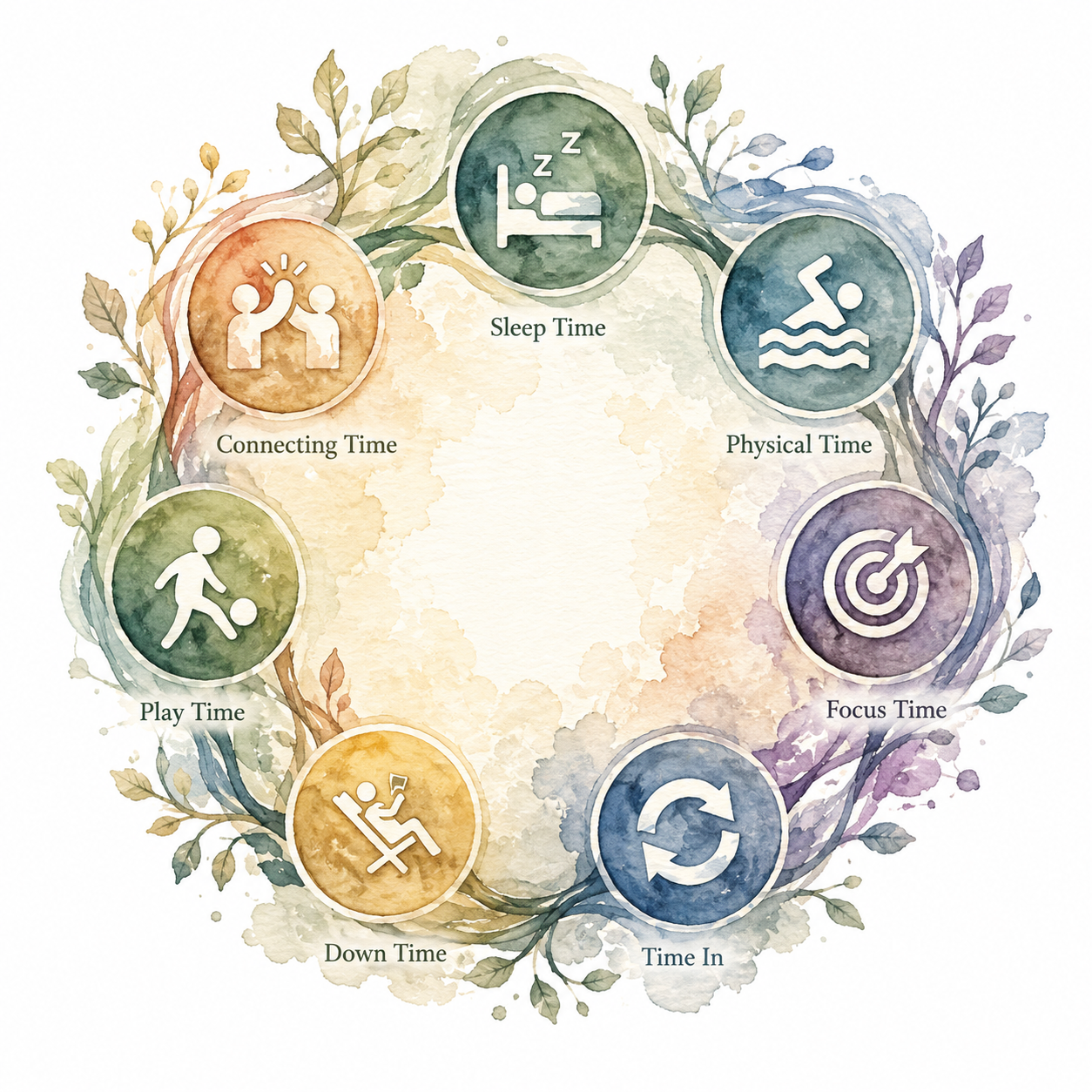
5. Time In
Mindfulness meditation. Quietly reflect on your internal sensations, images, feelings, and thoughts for better brain integration.
6. Down Time
Allow your mind to wander and relax. This recharges your brain.
7. Sleep Time
Adequate sleep is vital for learning, recovery, and overall brain health.